Many parents believe that early childhood mathematics begins and ends with reciting numbers from one to ten. But true mathematical thinking starts much earlier and runs far deeper than rote memorization. When a three-year-old intuitively grabs two cookies instead of one, or notices that a row of red and blue blocks forms a rhythmic pattern, they are actively demonstrating foundational number sense. In my homeschool workspace, I rely on preschool math readiness printables to transform abstract numerical concepts into tactile, visual discoveries.
Rather than drilling children with static calculation sheets, thoughtfully designed early math worksheets invite children to count, sort, group, and manipulate physical counters. By bridging tangible objects with visual representations, children develop genuine mathematical confidence that lasts well into elementary school.
Key Takeaways
Essential principles for nurturing early mathematical thinking with printables:
- Focus on one-to-one correspondence rather than just rote chanting of number sequences.
- Use ten-frame grids and dot patterns to foster early subitizing skills without counting individual items.
- Pair printable mats with physical manipulatives like counting bears, wooden blocks, or colorful buttons.
- Prioritize pattern recognition (AB, AAB, ABC) as a core predictor of future algebraic understanding.
To save weeks of curriculum planning and offer high-converting early math activities to your audience, Ready-made Kids Digital Products on plrbizhub.com provides commercial-use math readiness packs formatted for effortless customization.
Core Pillars Of Early Number Sense
Early childhood educators and researchers agree that math readiness encompasses far more than writing numerals. According to early learning position statements published by the National Council of Teachers of Mathematics (NCTM), high-quality preschool mathematics must engage children in active exploration, reasoning, and visual representation across multiple core competencies.
One-to-one correspondence
One-to-one correspondence is the ability to touch one object and say one number name, moving deliberately along a set of items without skipping or double-counting. Toddlers often count quickly – saying “one, two, three, four, five” while waving their hand over three items. Quality printables incorporate visual stepping stones, such as circular landing pads where children place exactly one physical counter per image, reinforcing the concept that each object represents a single numerical value.
Perceptual and conceptual subitizing
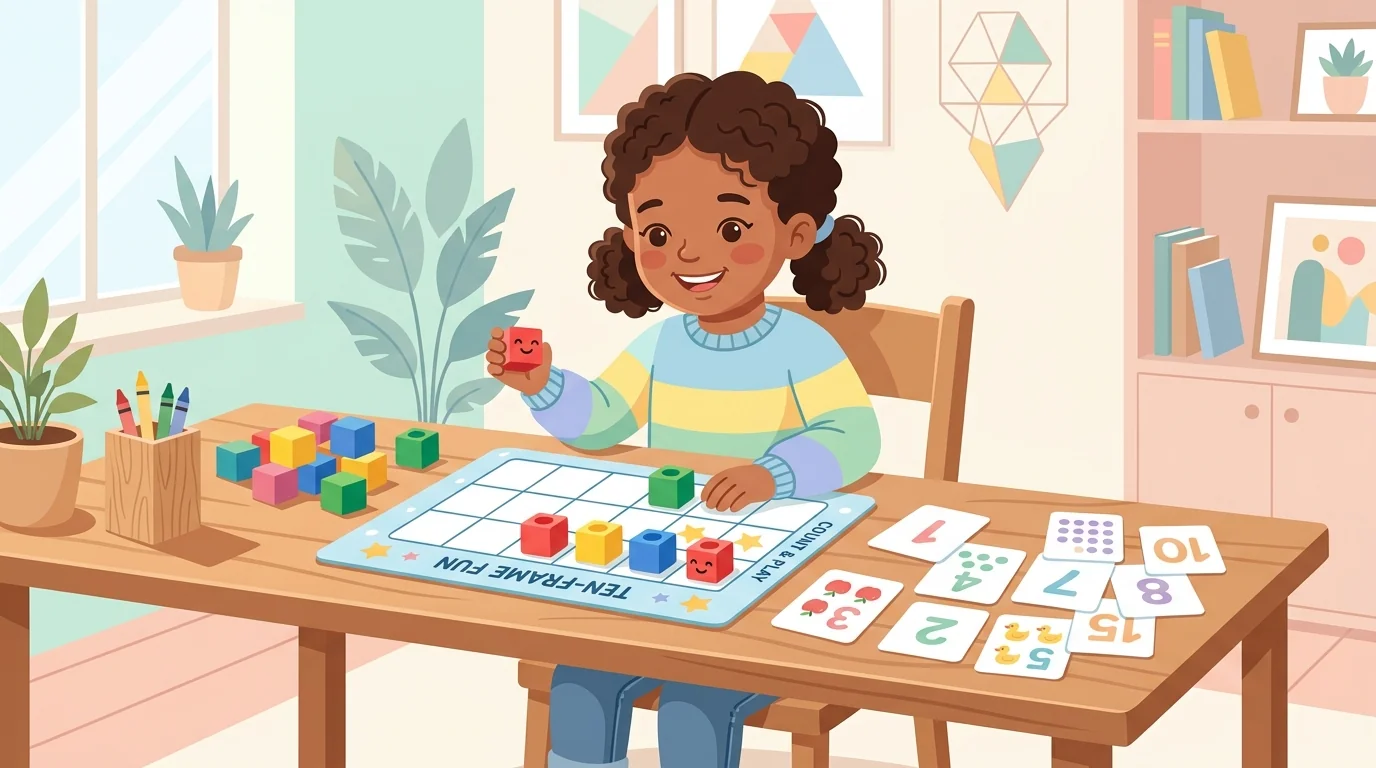
Subitizing is the capacity to recognize a small quantity of objects instantly without counting them one by one. Think of how you immediately recognize five dots on a rolling die. Perceptual subitizing covers small groupings of up to three or four items. Conceptual subitizing allows older preschoolers to see a cluster of four and two more dots, instantly recognizing six. Ten-frame printables and domino matching mats are exceptional tools for building this spatial number architecture.
Pattern recognition and sequence prediction
Patterns are the rhythm of mathematics. Identifying what comes next in an AB pattern (apple, banana, apple, banana) develops logical forecasting. When children work through pattern strip printables, they learn to analyze rules, generalize structures, and make predictions – cognitive skills that form the basis of algebraic reasoning later in education.
Spatial reasoning and geometric awareness
Before children measure angles or solve geometry problems, they must develop intuitive spatial reasoning. Tangram puzzle mats, shape silhouette matching sheets, and symmetry drawing printables teach young learners how figures rotate, slide, and combine to form new shapes. Engaging with these visual-spatial puzzles directly enhances mental rotation abilities, which educational research links to advanced STEM performance in later schooling.
Top Printable Formats That Build Hands-On Math Confidence
When selecting or designing early math downloads, variety keeps motivation high. Here are the most effective printable formats I use in our daily homeschool routines:
Ten-frame counting mats
A ten-frame consists of two rows of five rectangular boxes. It gives children a reliable visual benchmark of ten, showing clearly how many spaces are filled and how many are empty. On our mats, children roll playdough balls or place animal figurines onto the grid to represent a drawn numeral card. This simple layout bridges concrete counting with the decimal base-ten system effortlessly.
Number tracing and formation tracks
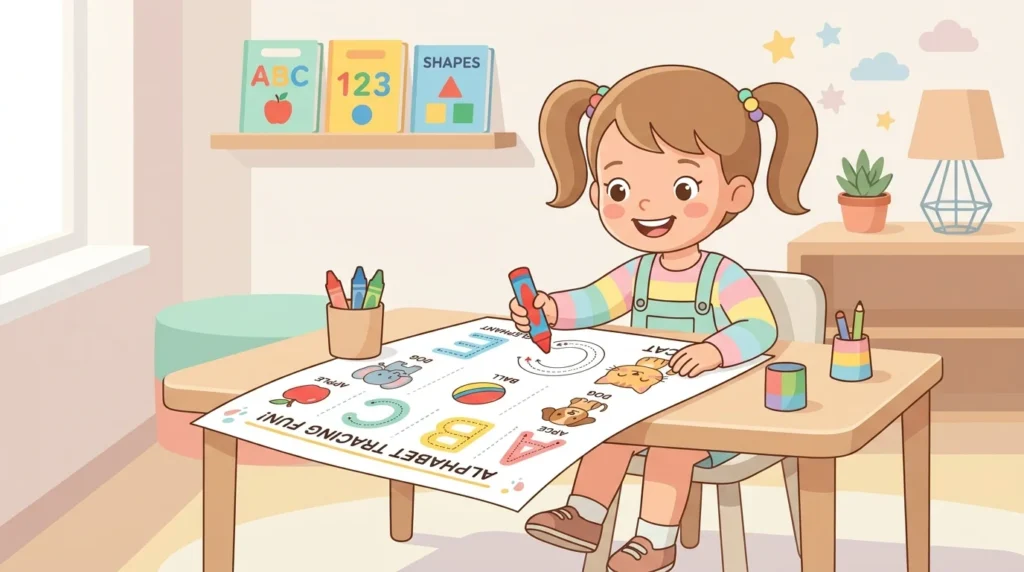
Learning to write numerals involves tricky directional shifts, especially with curved numbers like two, three, and eight. Much like our preschool alphabet tracing worksheets, number tracks should feature oversized paths with clear starting dots and directional arrows so children build clean motor pathways without frustration.
Size sorting and comparative measurement mats
Math also includes non-standard measurement. Printables that invite children to line up caterpillars from shortest to longest, or sort objects into heavier versus lighter columns, introduce vital spatial vocabulary. If you want a complete library of these exact templates ready for digital resale, the complete kids digital products bundle includes fully customizable Canva files that save hours of design time.
How To Organize Math Printables Into A Reusable Learning System
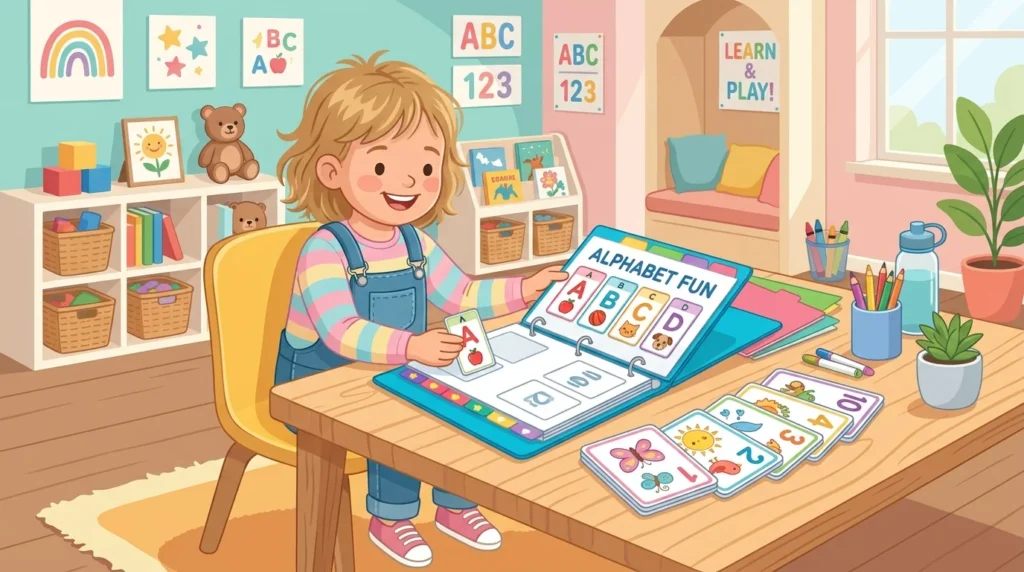
Printing new worksheets every day generates unnecessary paper waste and clutters your workspace. Creating a reusable math binder keeps your supplies neat and allows for repeated practice across multiple learning sessions:
- Print on Durable Cardstock: Use 65-pound smooth paper to prevent marker bleed and provide a rigid base for physical tokens.
- Heat Laminate or Use Dry-Erase Sleeves: Running pages through a thermal laminator with 5-mil pouches lets children write numbers with dry-erase markers and wipe them clean with a simple swipe.
- Store Manipulatives in Ring Pouches: Clip a transparent zippered pencil case into your binder rings to hold counters, dice, dry-erase markers, and number flashcards together.
- Sequence Pages by Difficulty: Organize your binder progressively, starting with one-to-one object counting, moving to ten-frames, and concluding with simple pattern strips and number formation.
This organized binder pairs seamlessly with our comprehensive guide to preschool learning binders and complements daily fine motor skills activity sheets.
Monetizing Early Childhood Math Printables Online
Digital printables targeting early math readiness enjoy steady year-round demand from both homeschooling parents and preschool educators looking for engaging classroom centers. Parents love the convenience of printing replacement sheets whenever their child needs extra reinforcement.
To maximize sales on platforms like Shopify, Stan Store, or your own WooCommerce store, bundle related printables into cohesive themed collections – such as “Farmyard Math Adventures” or “Space Explorer Number Sense.” Providing colorful mockup images showing real hands using counters on the page increases buyer conversion rates dramatically. You can discover more commercial printables business strategies at plrbizhub.com.
Frequently Asked Questions
At what age should children begin using math readiness printables?
Most children can start interactive math printables around age three, focusing initially on matching colors, simple counting up to three, and sorting big versus small objects. Structured number writing and ten-frames usually become effective between ages four and five.
What are the best hands-on manipulatives to pair with math worksheets?
Colorful counting bears, snap cubes, wooden pattern blocks, colored buttons, mini erasers, and rolled playdough balls are fantastic physical manipulatives. Having physical items to touch makes abstract numbers real and tactile for little hands.
How is subitizing different from counting?
Counting involves sequentially naming numbers while touching objects one at a time. Subitizing is the instantaneous visual recognition of a quantity without counting each item individually, much like recognizing the pattern of dots on dice.
Can I sell math printables created with commercial PLR templates?
Yes. Commercial PLR templates give you the legal right to customize the designs, add your shop branding, change color palettes or fonts, and sell the finished printable PDF files to your customers with zero royalties.
Early math readiness is an empowering process of discovery that flourishes when children connect abstract numbers to playful, tangible experiences. With thoughtful guidance and engaging printables, you lay a joyful foundation that sparks a lifelong love for learning.