
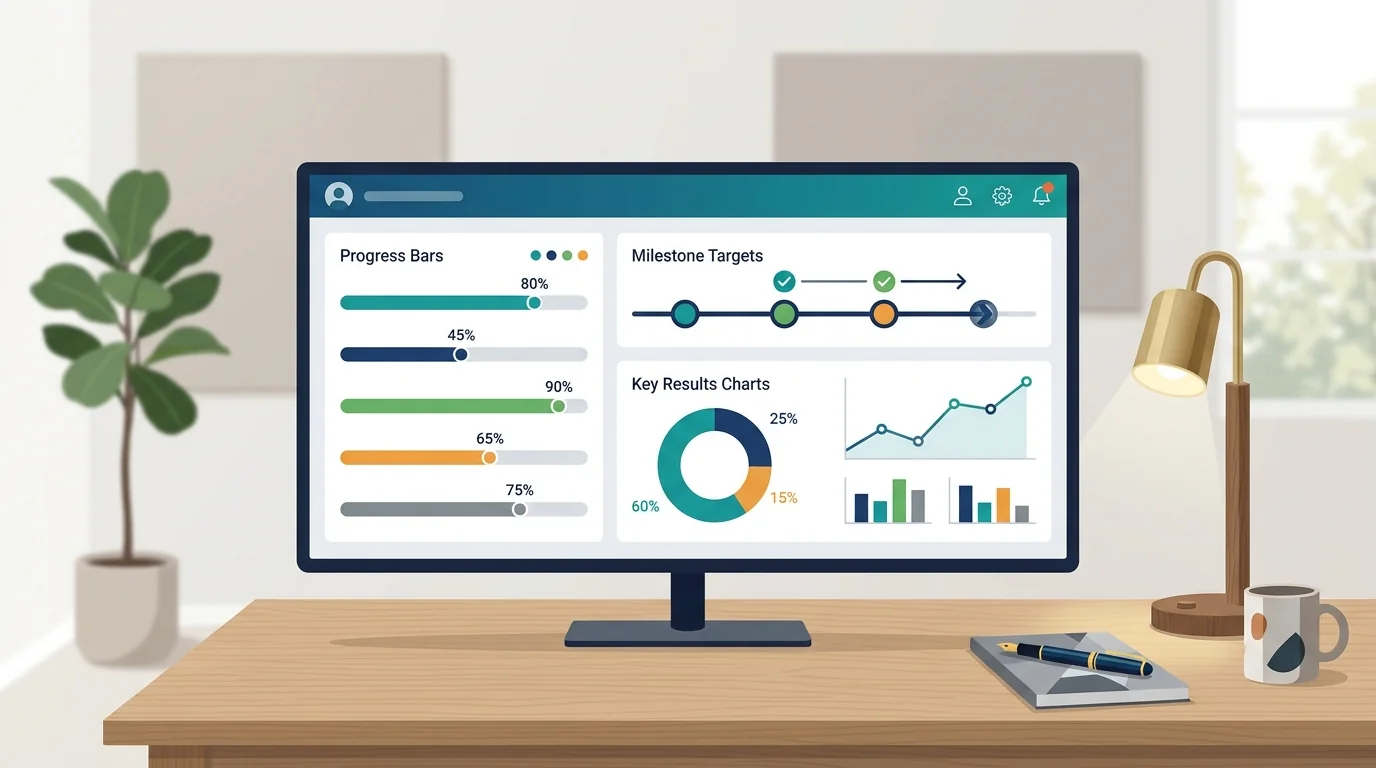
When I first attempted to configure a notion goal setting and okr tracking dashboard, my annual goals usually dissolved into forgotten intentions by mid-February. I would write inspiring declarations on New Year’s Day, bury them inside a pretty journal subpage, and completely lose sight of them while responding to everyday urgent emails and client messages.
Goal setting fails when high-level aspirations have no visible connection to daily execution. The Objectives and Key Results framework, when integrated inside Notion’s relational databases, creates an unbreakable chain between your broad vision, quarterly measurable metrics, and weekly project milestones. In this guide, I break down exactly how I built an automated goal-tracking architecture that keeps strategic priorities visible every single day.
Key Takeaways
Review these fundamental principles before constructing your goal dashboard:
- Differentiate qualitative Objectives from strictly measurable numerical Key Results.
- Link active daily projects directly to key results to ensure tangible operational momentum.
- Use native Notion formula properties to render dynamic visual progress rings.
- Limit active quarterly objectives to three focused goals to avoid divided attention.
- Incorporate mid-quarter check-in alerts to identify and correct off-track initiatives early.
To skip the design phase and start organizing productive systems immediately, Done for You Notion Templates on plrbizhub.com provide professionally formatted digital assets that eliminate setup fatigue while maximizing focus. These tested templates allow creators to launch their workspaces in hours rather than weeks.
The Core Mechanics Of The OKR Framework
Pioneered by Intel and popularized across modern tech enterprises, the OKR methodology detailed in academic studies on objectives and key results framework splits ambition into two distinct parts: where you want to go and how you measure your progress.
An Objective is qualitative, inspiring, and directional. For instance: “Establish our digital storefront as a recognized authority in productivity templates.” A Key Result is strictly quantitative, time-bound, and binary. Examples include: “Publish twelve comprehensive resource articles” or “Reach five thousand organic email subscribers.” When you pair an inspiring objective with three concrete numerical metrics, ambiguity evaporates. In Notion, we model this relationship using two relational tables connected by rollups.
Setting Up The Relational Databases
I build my goal tracking engine using two core databases: Master Objectives and Key Results. Separating these two elements into distinct tables provides tremendous structural flexibility and keeps individual records uncluttered.
In the Master Objectives table, each record represents an overarching quarterly aspiration. Properties include Target Quarter (Select: Q1, Q2, Q3, Q4), Life Area (Select: Career, Finance, Wellness, Relationships), and a Two-Way Relation property pointing to the Key Results database. I also add a Rollup property that calculates the average completion percentage across all linked key results, giving me a macro score for the objective at a glance.
In the Key Results database, each card contains specific quantitative metrics: Starting Value (Number), Target Value (Number), Current Value (Number), Unit (Text: dollars, subscribers, posts), and a Formula property calculating current progress. Connecting this table to my daily project pipelines guarantees that strategic intentions transform into operational realities. Each key result card also features a text property for logging periodic updates or contextual hurdles. For more workflow ideas, see our walkthrough on notion life operating system template setup.
Automating Visual Progress Calculation Formulas
Manually updating percentage sliders is tedious and prone to wishful thinking. In my setup, I use Notion formulas to handle mathematical calculations automatically based on raw numbers entered during weekly reviews.
The formula divides the difference between Current Value and Starting Value by the difference between Target Value and Starting Value. Notion’s native formatting options allow me to display this decimal as a clean percentage accompanied by a colored progress bar or circular ring. Seeing a visual bar update from thirty percent to sixty percent as I enter updated subscriber counts provides tangible proof of momentum. I also add a nested logic condition that caps the displayed percentage at one hundred percent so overachieving a target does not distort layout formatting.
If you prefer a pre-built workspace that handles these formulas, rollups, and dashboard views automatically, the 200+ PLR Notion Templates Bundle delivers complete OKR tracking hubs ready for commercial and personal deployment.
Connecting Key Results To Active Project Hubs
A key result without assigned projects is merely a wish. The true breakthrough in my workflow happened when I established a relational link between Key Results and my master Projects database.
Whenever I create a key result, such as “Generate ten thousand dollars in template sales,” I immediately brainstorm the exact projects needed to move that needle. Projects might include launching a new product bundle, writing weekly promotional newsletters, and updating storefront checkout pages. By linking these active projects directly to the key result card, I can open the goal in Notion and view every supporting initiative in real time. If a key result has zero active projects attached, it serves as an immediate red flag that the goal is being neglected. For digital creators building scalable assets, review our blueprint on how to start PLR product business from home, as well as the resources on plrbizhub.com.
Conducting Mid-Quarter Goal Audits
Setting goals at the start of a quarter and only checking them at the end is a recipe for missed targets. I conduct a structured thirty-minute goal audit at the midpoint of every quarter, typically during week six.
During this check-in, I assign a confidence status to each key result: Green (On Track), Yellow (At Risk), or Red (Off Track). For any metric flagged as Yellow or Red, I do not simply work harder. I critically examine the underlying projects. Often, the original project strategy was flawed, or external circumstances shifted. Pivoting my active projects mid-quarter gives me six full weeks to recover and hit the target rather than discovering failure on day ninety. Documenting the rationale behind these adjustments directly on the objective page provides invaluable historical insights for future planning cycles. To see how these audits tie into regular weekly routines, consult our guide on notion weekly review dashboard workflow.
Designing The Executive Goals Dashboard
Your high-level goal dashboard should serve as an inspiring executive briefing rather than an overwhelming data dump. I configure my executive page with a clean gallery view showcasing active quarterly objectives.
Each gallery card displays the objective title, the target quarter tag, and the aggregated progress rollup ring. Clicking into any card reveals the linked key results along with their child projects. Keeping this high-level summary bookmarked in my Notion sidebar ensures that my strategic compass remains visible during my morning planning sessions, keeping my daily decisions anchored to my highest ambitions.
Frequently Asked Questions
How many OKRs should I set per quarter?
I recommend setting no more than three objectives per quarter, with each objective supported by two to three measurable key results to maintain clear focus.
What if my key result cannot be quantified with numbers?
If a result cannot be measured numerically, reframe it as a milestone deliverable with a binary complete or incomplete status, such as completing a certification course.
Should I change my key results mid-quarter if priorities shift?
Yes. If business or life realities change fundamentally, adjust your key results immediately rather than working toward an obsolete milestone.
Building a transparent OKR system in Notion bridges the divide between visionary planning and daily execution, keeping your highest goals within tangible reach.